
Residences at Lawrence Hill: First Impressions
Author: Farrukh Najmi
Photo Credit: Carl Sussman (unless stated otherwise)
On Wednesday, January 7th, as a member of Maurice's Planning Committee, I went on a tour of Residences at Lawrence Hill, led by Jay Coburn, head of Community Development Partnership (CDP).
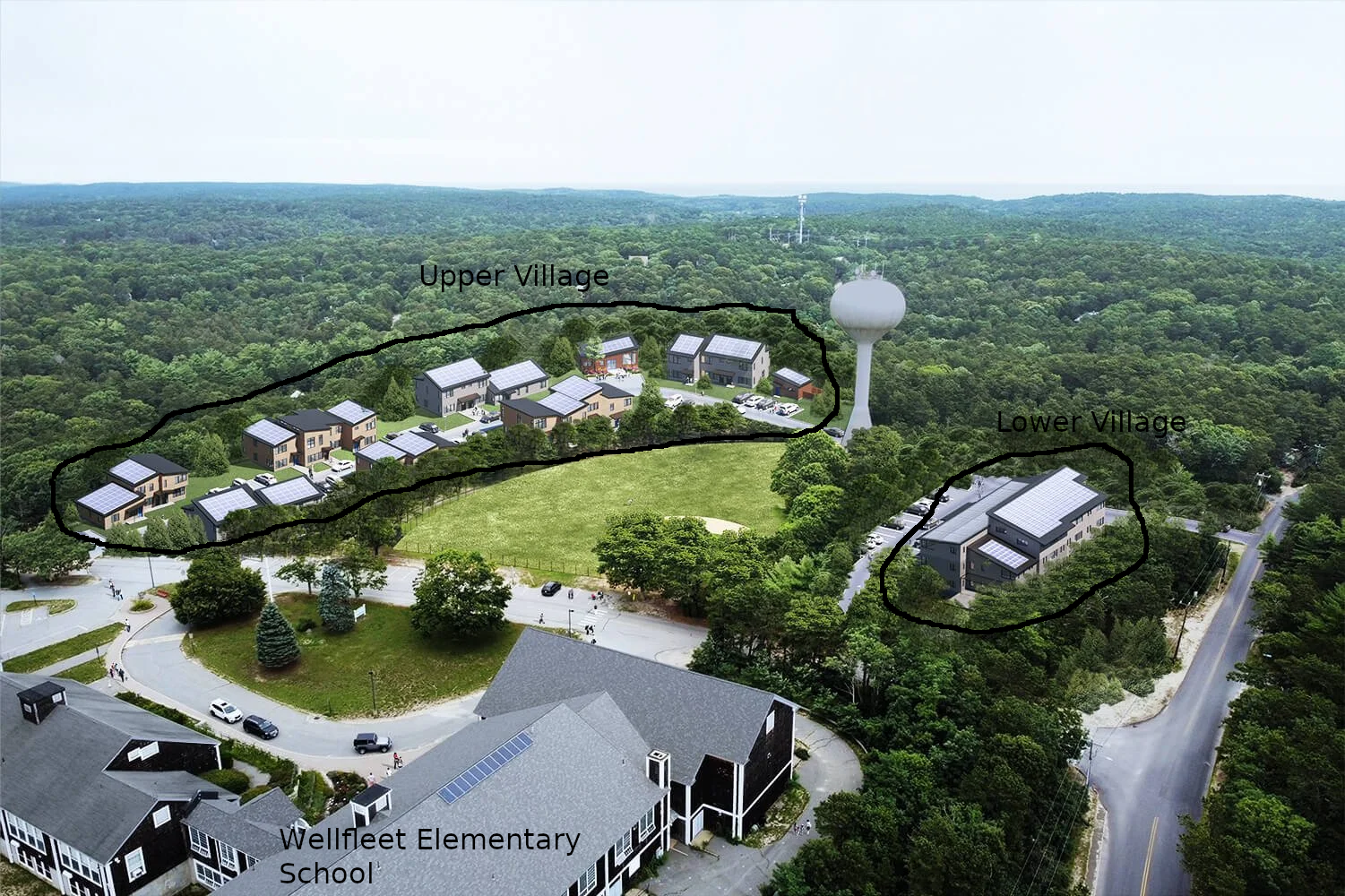
Photo credit: https://www.wellfleethousing.org/95-lawrence-road-project (Photo is not an actual image but an early vision of what the site would eventually look like)
The site consists of 46 units of affordable housing located across the street from Wellfleet Elementary School. The Upper Village consists of 24 units spread across 7 two to four-unit townhouses, and a community building, and the Lower Village consists of the elevator building with 22 apartments. Among the total 46 units, there are sixteen (16) one-bedroom units, twenty-five (25) two-bedroom units, and five (5) three-bedroom units [1]. The existing baseball field will remain at the center of the development. There is an accessible walkway connecting the two villages via a pleasant walking loop.
I like bright colors. My first observation was that the colors of the buildings are muted, and I wished that they were more vibrant. However, I realized that these earthtone colors blend in much better with their surroundings, even more so when the trees in the development reach maturity. I looked around with low expectations, as all I had heard from social media posts was how these buildings were ugly and did not reflect a Wellfleet vibe. I was very pleasantly surprised. On the outside, the buildings looked quite attractive. Even the one 3-story building in the Lower Village looked attractive from the interior of the development. Later, when I looked at it from the Long Pond Road side, it did loom large, given that it is on the slope of a hill. I hope this will be mitigated when the trees reach maturity on that side.
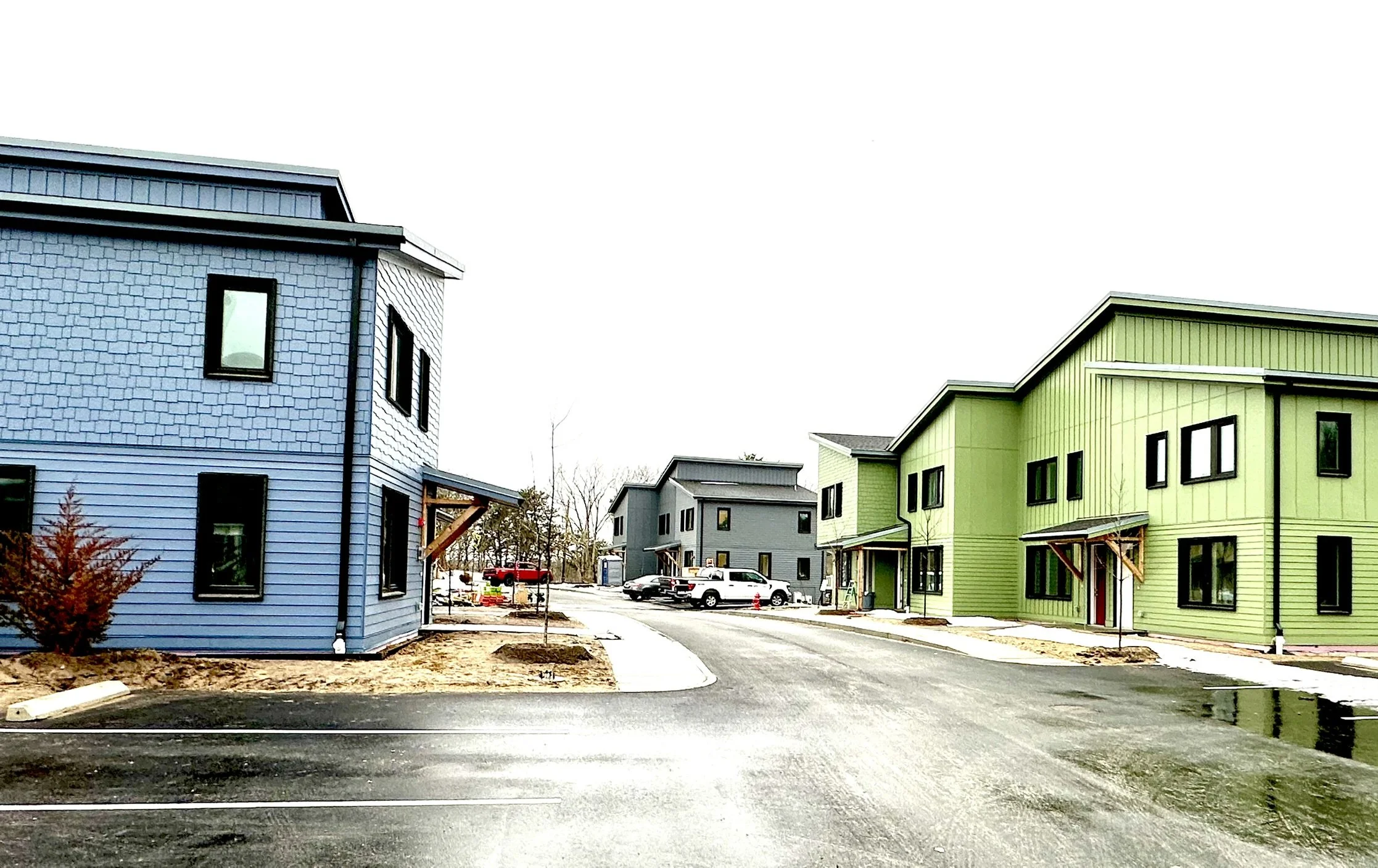
A View of Upper Village
2-Bedroom, 1-1/2-Bath Townhouse
First, our group entered one of the 2-bedroom, 1-1/2-bath units of a duplex in the Upper Village. The apartment was on two floors. The first floor had an open living room, a decent kitchen, and a half-bathroom. The second floor featured a full bathroom and two spacious bedrooms, each with appropriate closets. The entire apartment was well-lit with large windows and a high 9.5-foot ceiling. The window treatments were already installed, ready to provide privacy and insulation as needed, and the windows could all be opened. The windows on both floors had lovely views of the surrounding undisturbed woods. I appreciated very much that all the windows that I saw could be opened. On the first floor, I noticed that the heating vents were near the ceiling rather than the floor. Later, Jay shared that the buildings use an air circulator to move the heated air around and also to compensate for the very tight energy-efficient seal on the apartments. As a testament to the tight seal, although the heat was not on, we felt quite comfortable in the apartment when the outside temperature was 38°F (3°C). There is more on energy efficiency later in this article.
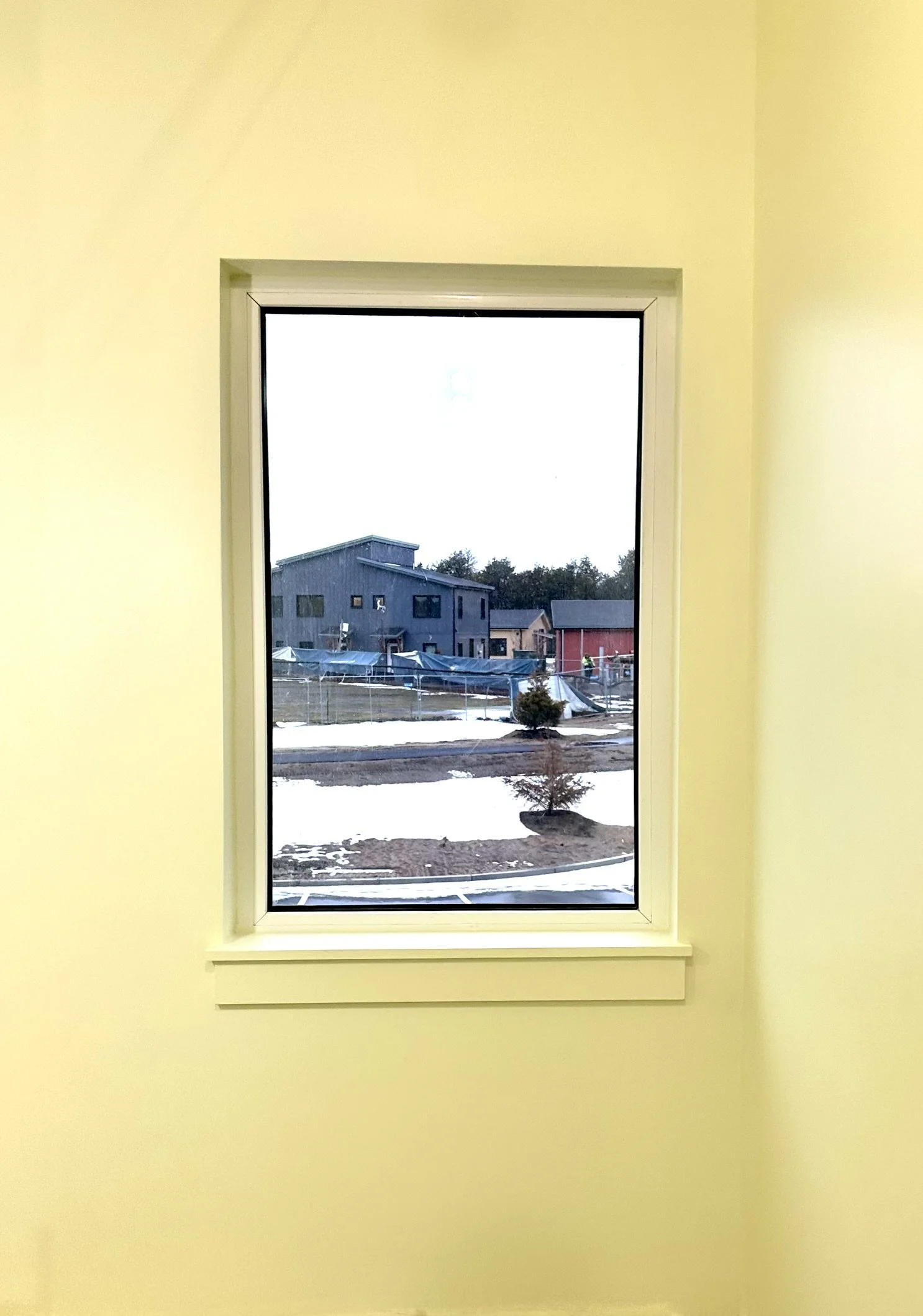
A window in the 2-bedroom Townhouse
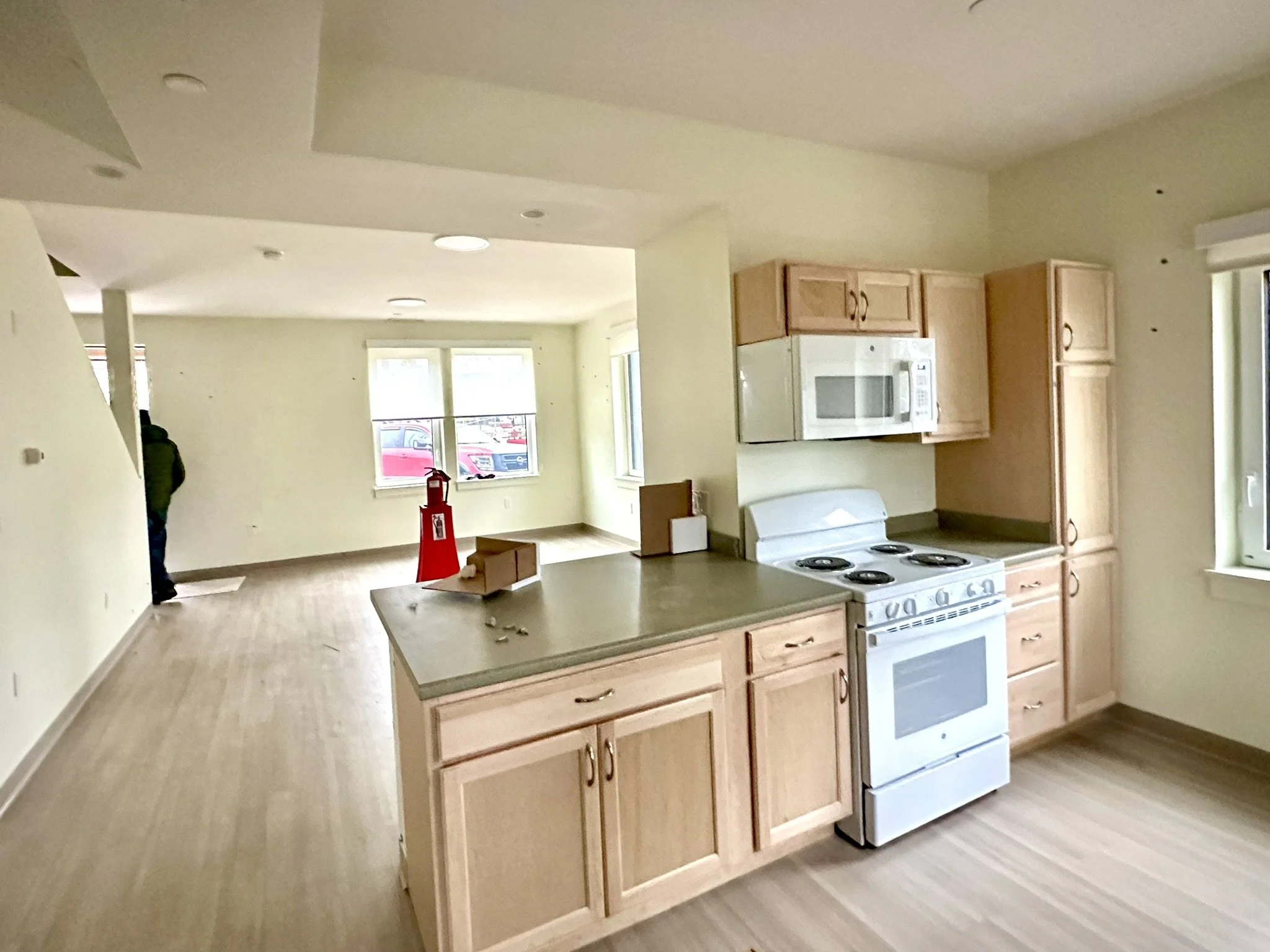
View from the kitchen looking towards the front of the 2-bedroom Townhouse
3-Bedroom, 1-1/2-Bath Townhouse
We then saw a 3-bedroom, 1.5-bath apartment. It was very similar in its interior to the 2-bedroom, 1.5-bath apartment in its design, except that there were 3 bedrooms upstairs. Again, it was a spacious, well-lit apartment with 9.5-foot high ceilings.
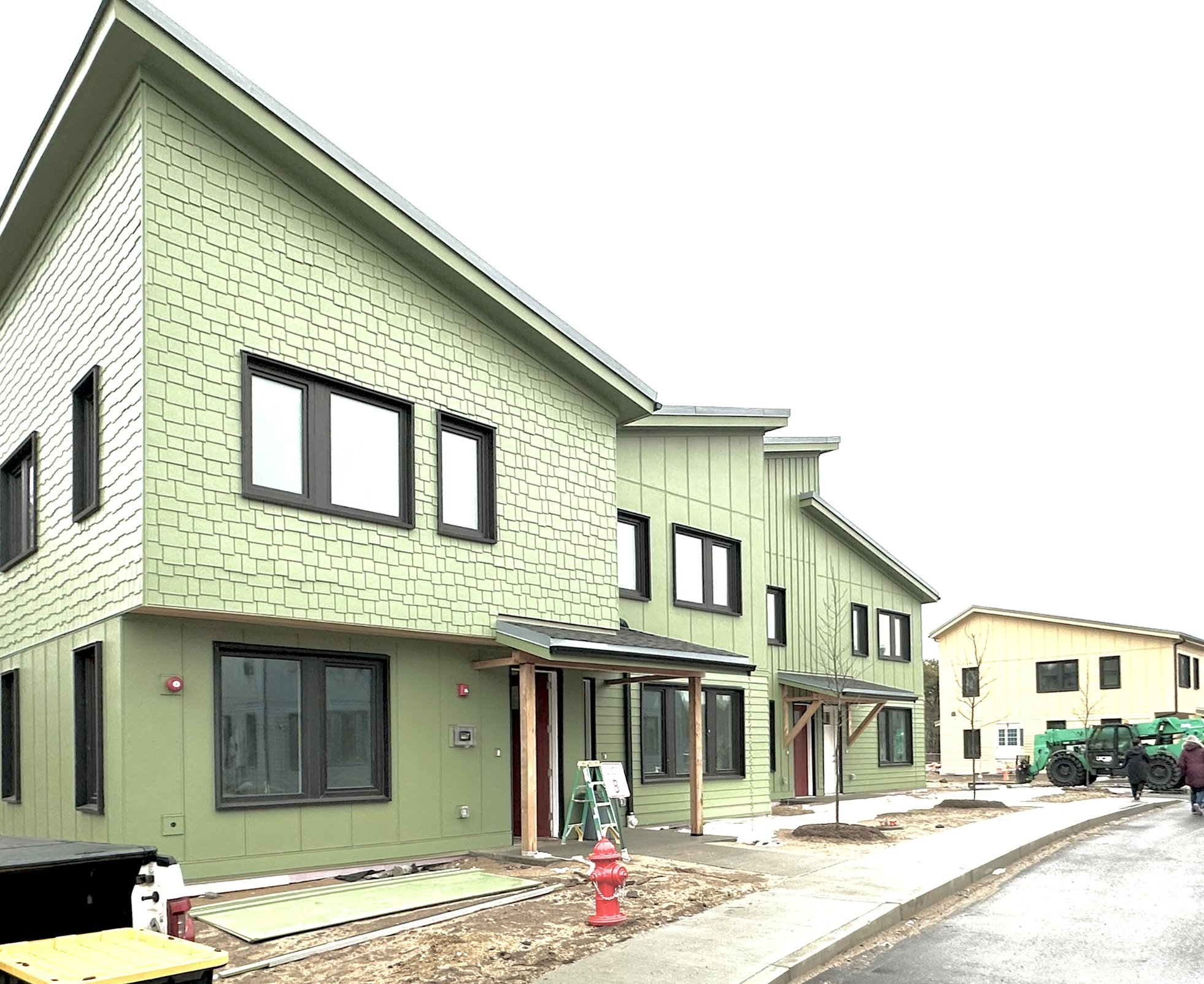
Exterior of a Townhouse building
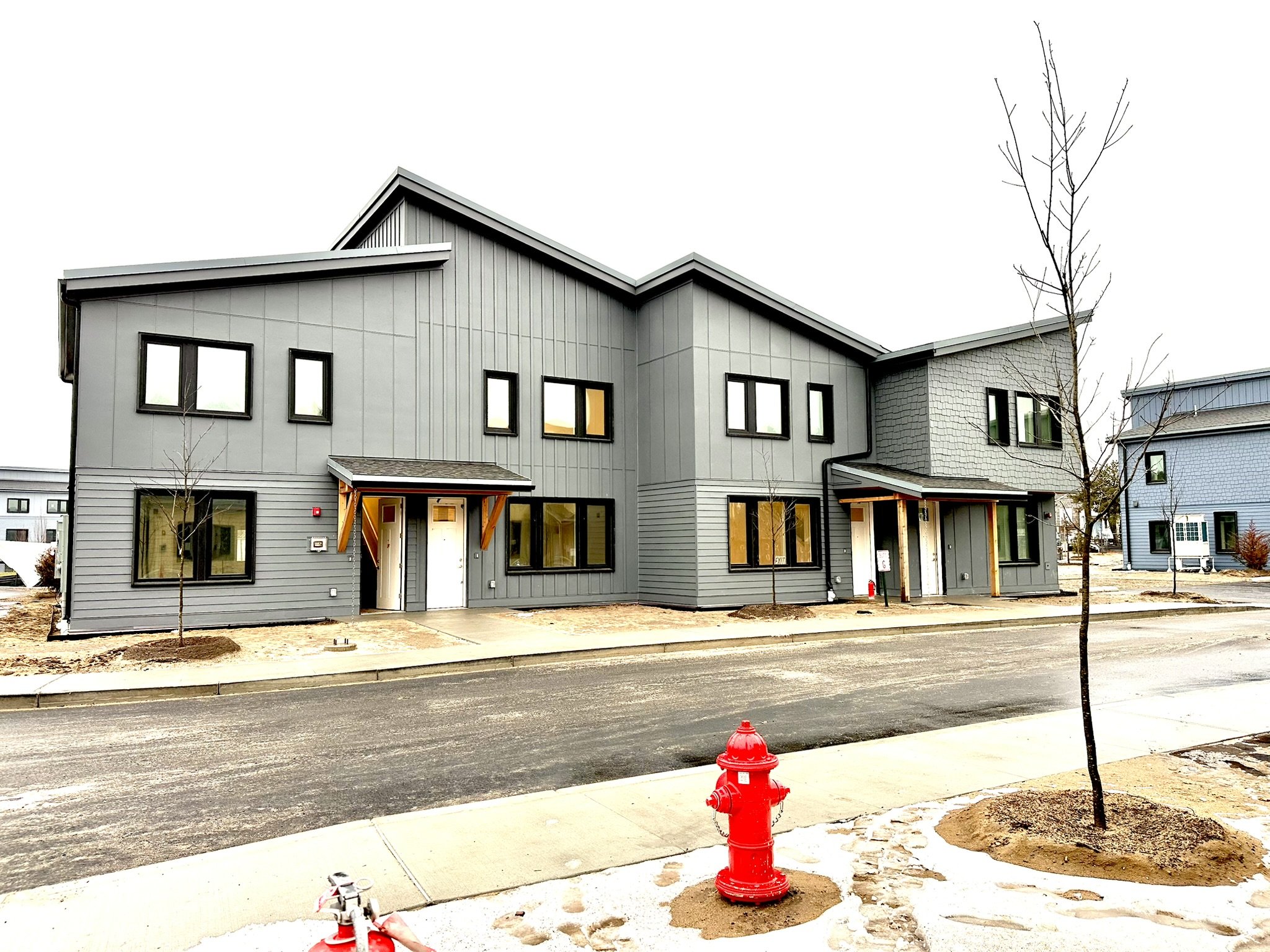
Exterior of a Townhouse building
Mobility Accessible Unit
Next up, we saw a Mobility Accessible unit, designed for wheelchair access, ease of movement, and full compliance with the Americans with Disabilities Act (ADA). The 2-bedroom apartment was on a single floor with appliances, countertops, light switches, thermostats, and doors with lever handles, placed at lower, reachable heights. There are two additional mobility-accessible units and one hearing-impaired unit on the site that we did not see during the tour. It is noteworthy that the first floors of all buildings on the site are wheelchair accessible.
Community Building
Our next stop was the Community Building in the Upper Village. Immediately inside the entrance is where the resident mailboxes and package concierge system for the entire site, will be conveniently and centrally located.
Beyond the entrance is the shared laundry room for the Upper Village. There were four pairs of washers and dryers there. A question was asked why none of the apartments have their own private washer and dryer. Jay replied that it was much more cost and space-efficient to install and maintain shared equipment than equipment that is spread out in individual units. Next to the laundry room was a good-sized community room where residents could congregate, watch TV, play games, and enjoy a cup of coffee with their neighbors while their laundry was being washed. The room had sloped ceilings. Like the apartments, it was well-lit with large windows. It will even have a galley kitchen and a patio accessed via a back door that will have BBQ grills. I thought the Community Building was beautifully and thoughtfully designed.
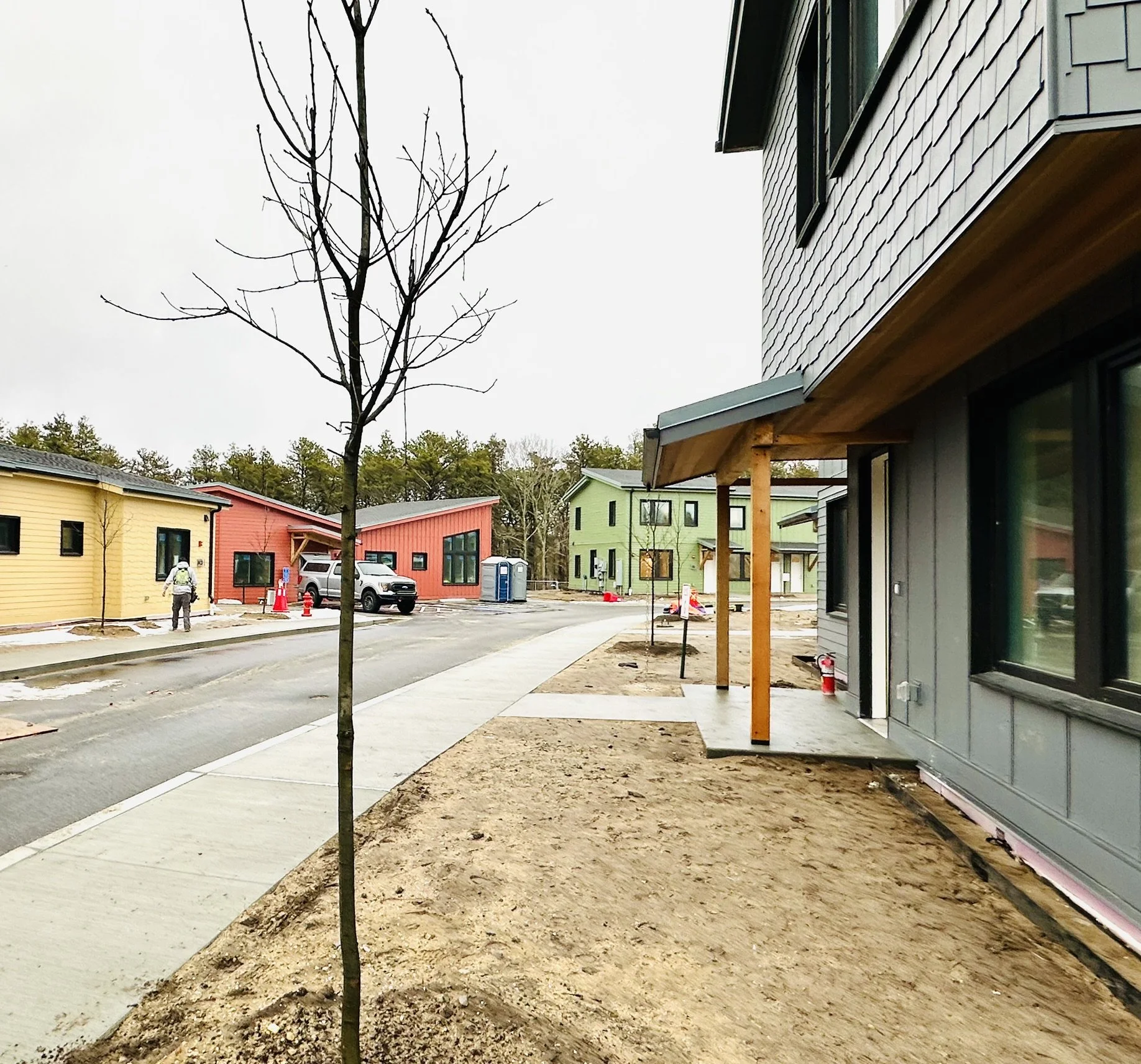
Mobility Access Unit (yellow) and Community Building (reddish)
Elevator Building - Lower Village
We then took a short walk to the only elevator building that constituted the Lower Village. During the short walk, the ball field was to our right, and on our left, in front of us was the Wellfleet water tower. Near the water tower were some lovely shared patios and a community garden.
We entered the elevator building on the first floor through a wheelchair-accessible entrance. Much of this building was an active construction zone. The elevators were not functional yet. We took the stairs to the third floor. The floor had a long hallway running along its length and doors to 1 and 2-bedroom apartments on both sides. There were no functioning lights, so naturally, it seemed a bit dark. The long hallway seemed a bit institutional.
We did a tour of a 1-bedroom apartment. The apartment was still under construction, had ample room for two people, and was well-lit with decent-sized windows. It seemed like an attractive entry-level housing option for a single person or a couple. We came back down to the first floor via the same staircase. Next to the staircase was the Community Room for the Lower Village. It was under construction, but it plans to have similar amenities to the Community Room in the Upper Village. We finished the tour of the elevator building by visiting the basement. This is where the shared laundry facility for the Lower Village, consisting of 4 pairs of washers and dryers, is located. The basement also provides secure storage for the residents of the entire site on the interior side, as well as open storage on the Long Pond side for larger items such as bicycles and kayaks. The basement storage area is ADA-accessible. An important design consideration of the elevator building is to allow aging in place.

Exterior view of the front of the Elevator Building
Energy Efficiency
The entire development is a Net-Zero design based entirely on electricity produced by rooftop solar panels, avoiding the use of any fossil fuels. The site is designed to produce as much renewable solar energy as it consumes annually, balancing energy use with on-site solar electricity generation to achieve zero net operational carbon emissions. The tight seal on the building and continuous ventilation for high indoor air quality are because the buildings are designed to comply with the Passive House Standard (PHIUS Certified). As part of the PHIUS certification, the windows of the apartments have energy-saving window treatments pre-installed. We learned that the buildings in the Upper Village, as energy-efficient as they are, are not self-sufficient in their energy consumption. The one elevator building of the Lower Village is so hyper-energy-efficient that it produces surplus energy that compensates for the lesser efficiency of the Upper Village, resulting in a Net-Zero energy consumption for the entire site. Jay explained that buildings that are 3 or more stories high have much better energy efficiency than 1 or 2-story high buildings. He also noted that the building cost of the elevator building was 30% less than the building cost of the Upper Village.
Sewage Treatment
We did not see the sewage treatment system during the tour as it was under construction. It is an advanced cluster wastewater treatment system that will serve not just the 46 units of the development but also the nearby Wellfleet Elementary School, the police station, the fire station, and some existing private residential properties. The result is the cleanest wastewater in the town of Wellfleet, and is projected to reduce the town's nitrogen emissions into waterways by 263 kilograms per year!
There are anticipated delays in the new sewage treatment plant's being operational. An interim plan is in place to use "tight tanks" (holding tanks). These will be regularly pumped, and waste will be trucked away until the new sewage treatment plant is operational. The Town is responsible for building the sewage treatment facility, funded by a grant from the State. The Town has a separate contract with a different contractor to build the facility, with a competition date later than the homes.
Summary Impressions
First, I would like to express my appreciation for the development team of CDP and POAH. Jay Coburn, the CEO of CDP, who led the tour, with all his deep experience and knowledge, was a down-to-earth, unassuming, and approachable person. In the past, he had been very responsive when I had emailed him with concerns regarding restrictive pet policies. The CDP and POAH have considerable expertise in developing and managing over 120 affordable properties containing over 100,000 units of housing across the country, including 500 units on Cape Cod. I felt that these two non-profits are not faceless corporations, but rather, are made of people from our community who are passionate about their work and have a deep commitment to improving the lives of low and moderate-income residents.
I had gone on this tour with reduced expectations, as there had been a lot of negative hubbub on social media about it. I came away very pleased and impressed with what I saw. I particularly appreciated the thoughtful attention to its design in support of bringing the community together, lowering nitrogen levels in the delicate ecosystem of our waterways, and keeping the energy consumption to Net-Zero.
The one aspect of design that could be improved and may well be in-progress is to use architectural techniques to make the hallways in apartment buildings not look institutional. These could include avoiding a single line of lighting, visual breaks using differing colors on walls and apartment doors, mirrors on one or both walls to reflect light to create the illusion of a wider, more open space, and flooring improvements using runners to add color, texture, and pattern.
Beyond functional design, I found the aesthetics of the development quite appealing. Walking around, looking past the active construction, it felt like an attractive neighborhood, and the scale felt comfortable. If I were seeking affordable housing, I would consider it my good fortune to be living in this beautiful development.
